HillTown Studio Longform Content

development

#theory #weardcynn #development

I've been tinkering around with this system for a while, with little publicly to show for it. But now I want to give a glimpse of the schematic for a character class in Weardcynn. The aim here is to show how I'm thinking about classes, and how I want them to function. I owe some of this schema to Pathfinder 2e, even though it is mechanically quite different. Whether this ends up being a final product or not, I can't say.

One thing to note about classes in Weardcynn is that they are fonts of specific expertise. Like characters in many other OSR and NSR systems, Weardcynn characters have a base set of adventuring competencies: they can fight, they can camp, they can walk long distances, they can climb stuff, they can use ropes, and they know a bit about assessing treasure, plants, animals, other peoples, and typical structures. They only need an appropriate Action to deal with these if the situation requires it. But character classes take those adventuring competencies and dial up the expertise. Anyone can fight, but a Fighter is an expert at it, trained to help his companions focus their attacks on a foe's weaknesses, or bring a fight to more favorable terrain, etc. Likewise anyone can hunt game, but a Hunter can doggedly track down even the most elusive prey, including other people if necessary.

Hopefully what I've written below captures the essence of a character class so that you can tell quickly what its expertise is, and how you might play it at the table. Don't worry too much about the mechanics for the one Action that's detailed here. The Action is included to help convey that expertise, and while the mechanics do matter, they aren't the focus here. That said, I am interested in what impressions people have of how the Action works.

Read more...

#Dolmenwood #resources #development

Haggryme

The Fading of Winter, 3rd Month of the Year

5FriskThe Feast of St. Clister.
6EggfastThe Feast of St. Ponch.

Pluritine Observances: Release of stick, bark, and leaf boats down local waterways and making food offerings to feed the lost in hopes of guiding them home.

11MootThe Feast of St. Flatius.
12FriskThe Feast of St. Quister.

Pluritine Observances: It is customary to bring your to the local priest at mass for a blessing of the animals. Clergy make rounds among the farmers bestowing such blessings on livestock.

13EggfastThe Feast of St. Aeynid.
18MootThe Feast of St. Visyg.
22CollyThe Feast of St. Pannard.
23ChimeThe Feast of St. Simone.
25MootThe Feast of St. Sortia.
27EggfastThe Feast of St. Pastery.

Pluritine Observances: Priests and clergy visit local wells and bestow blessings on them. People makes a feast from a winter calf. The largest such observances are in and around Lankshorn.

28SunningThe Feast of St. Bethany.
29Yarl's DayThe Feast of St. Tumbel.
30The Day of VirginsThe Feast of St. Lillibeth.

Pluritine Observances: Folk fashion or buy folded paper doves on which they write their afflictions. These are offered in supplication in hope that St. Lillibeth will intervene to cure them. In Meagre's Reach, people construct a bonfire in the village square in which to offer their doves.

++++ Like what you just read? You can subscribe to new posts on this blog via any ActivityPub platform (Mastodon, Pleroma, etc.) at @aaron@blog.hilltown.studio or via RSS at https://blog.hilltown.studio/feed
#Dolmenwood #resources #development

Continuing from the last post, here's the Lymewald entry, with detail for the major saints' days. This is the target styling for the entire Book.

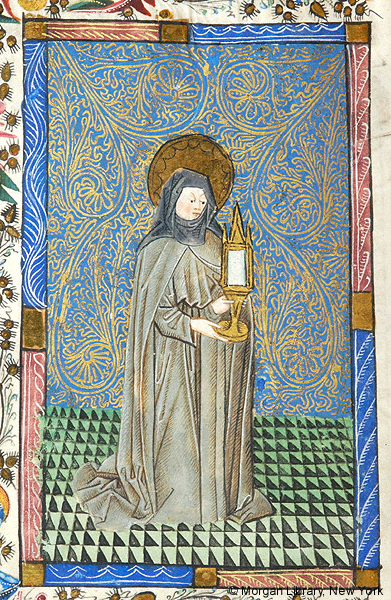
Nun holding a reliquary. Source: The Morgan Library and Museum

Lymewald

Deep Winter, 2nd Month of the Year

2ChimeThe Feast of St. Waylord.
3HaymeThe Feast of St. Gondyw.

Pluritine Observances: Blackeswell hosts the largest observance, where the people put on a pageant showing the old kings converting to the Pluritine faith and driving out the "snakes" of the old religions. Smaller pageants occur elsewhere.

9ChimeThe Feast of St. Calafredus.
15CollyThe Feast of St. Wynne.
19FriskThe Feast of St. Albrith.
23ChimeThe Feast of St. Fredulus.
28SunningThe Feast of St. Eggort.

Pluritine Observances: It is custom to keep a simple beeswax candle lit through the night, from sundown on the 28th of Lymewald to sunup on the 1st of Haggryme. This is said to help guide lingering souls to the afterlife.

++++ Like what you just read? You can subscribe to new posts on this blog via any ActivityPub platform (Mastodon, Pleroma, etc.) at @aaron@blog.hilltown.studio or via RSS at https://blog.hilltown.studio/feed

#Dolmenwood #resources #development

I started playing around with the Dolmenwood calendar recently, as I was gearing up for my upcoming campaign. Initially, I was just going to write down in an Obsidian page my own collection of folk and religious observances for the major feast days and pre-Pluritine holidays, but when I re-encountered Grisly Eye's vellum-doc project again, I decided to give that a whirl.

I started with House Rules but then decided to import some of my calendar entries to see how those looked in the same setup. I had already committed to using medieval illustrated manuscripts as imagery, and it wasn't long before I came across historical examples of Books of Hours, which, as luck would have it, usually include calendars of feast and saints' days. And thus was born the Dolmenwood Book of Hours.

Now, I have considerable work left to do on it, so what I will do in a series of posts here is detail each month's major feast days and whatever folk holidays I plan to include myself. Once the major saints and holidays are accounted for, I will go back and create smaller, less grandiose observances for the saints who merited only a mention in one table in the Dolmenwood Campaign Book.

The methodology for creating these observances for major saints is as follows:

  1. Determine if the saint is the patron saint of anything in particular. If so, build an observance around that patronage. If not...
  2. Try to find the blessing associated with the saint, then see if it makes sense to build an observance around that. And if not...
  3. Use the epithet attached to the saint, on the assumption that the epithet says something useful about the saint where the lore itself does not.

Since there are 34 major saints, plus a smattering of other holidays (mostly folk stuff), the work is approachable if time consuming. There are 100 saints in all, however, and since the remaining saints may have only epithets attached to them, I'll have to basically invent lore for most of them. I will take the lack of lore for these as an invitation to brew my own, knowing full well that a later supplement may obviate this effort. In the meantime, the Book of Hours

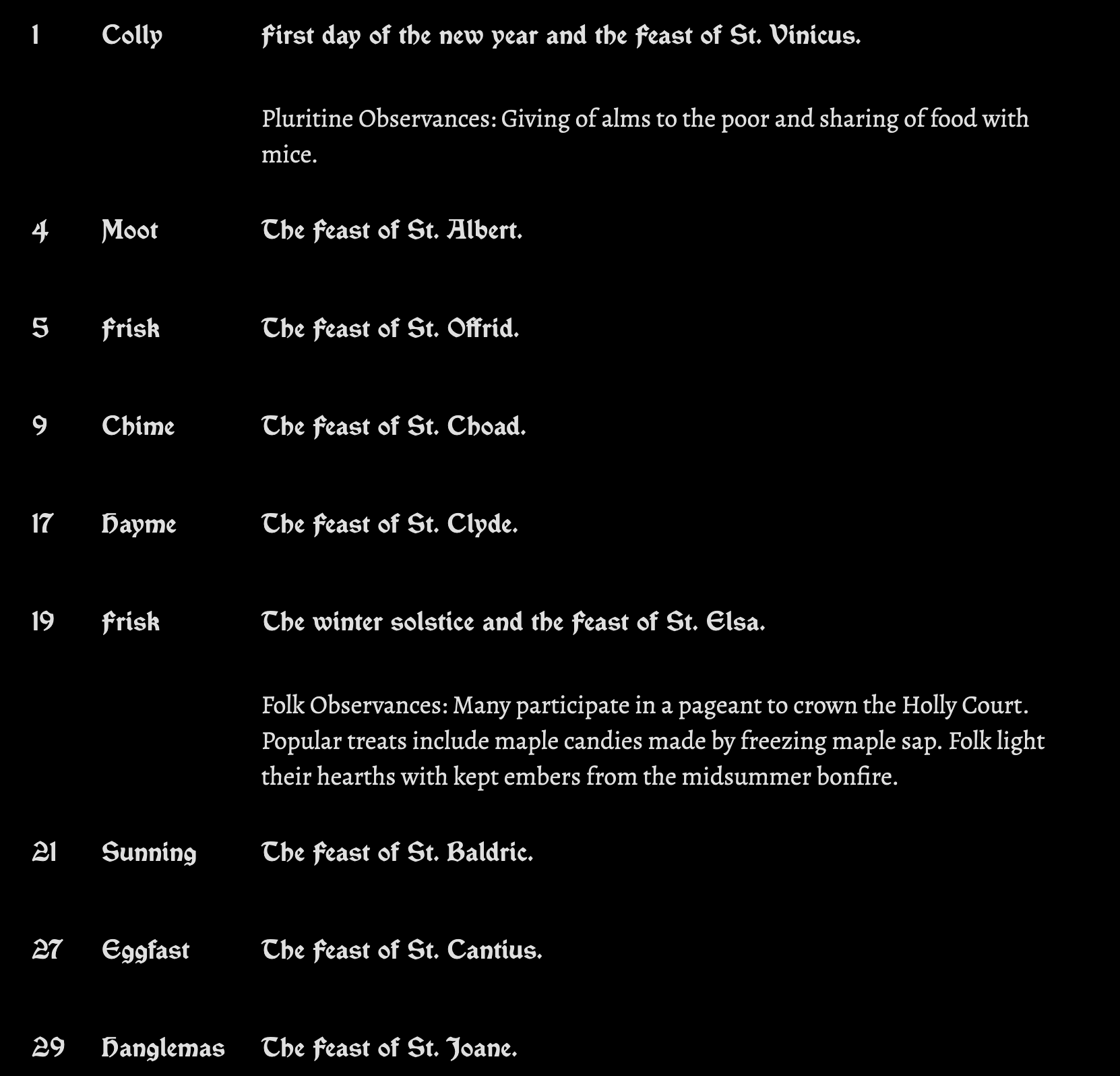
In any case, here is the list for Grimvold, The Onset of Winter, 1st Month of the Year.

Grimvold

++++ Like what you just read? You can subscribe to new posts on this blog via any ActivityPub platform (Mastodon, Pleroma, etc.) at @aaron@blog.hilltown.studio or via RSS at https://blog.hilltown.studio/feed

#weardcynn #development

One of the chief concerns of a fantasy-adjacent TTRPG is magic. In Weardcynn, I am aiming for a magic that is grounded in several senses. One is the pagan/animist sense, in which the magic user (generally termed in my game as Wyrdwyrhtas, or literally Fate Workers) persuades and manipulates the spirits that inhabit all things into performing tasks. They do this by using Wyrdwegas (literally Fate Ways). There are limits to what can be achieved, and all magic costs, but the ultimate source of it is the vast well of animating spirits that comprise the world. These spirits are often mercurial and uncooperative, so must be tricked or captured in various ways, but they are ubiquitous, representing the divisions within divisions that reflect and refract through all creation.

Read more...

#weardcynn #lore #development

The setting for Weardcynn is implied within the main rules text. That doesn't mean there isn't a more coherent setting present. I am building this new earth in the image of William Blake's already fallen/always falling Albion with his Zoas and Emanations. In this telling, the fourfold giant that comes to know itself as Albion stirs from within a great deep, void, or unknowing. This is perhaps akin to a Big Bang moment, from which all things proceed, representing the division of all things from the singularity that birthed them.

Physics likewise infuses other aspects of this process. For each action, as we know, there is an equal and opposite reaction, and this remains so even in the stirring of Albion from the deep. Albion is the action that spawns the immediate reaction, and his equal and opposite, or his reflection or emanation, is known as Jerusalem. Here Blake is appropriating and reshaping Biblical concepts into something else, and I am preserving as much as makes sense for what I'm doing.

Now, the awakening of Albion and the casting of his reflection as Jerusalem represents the first Fall, because it results in immediate division of what was previously a unity. But Albion is not finished falling. In fact, he will continue to fragment into countless pieces, and some of those pieces claim dominion over the others or, in some cases, claim to have created them. The eight chief fragments of Albion are the four Zoas and their respective Emanations.

This continual falling or fragmentation is the ongoing Fall that is at the heart of what I call the Schismata (which is also the name for the set of mechanics that underlie this system). This is my own embellishment and has nothing directly to do with Blake. It represents the idea that everything is already fallen and always falling further from unity, and will continue to do so until the harvest after the Final Judgment reunites all of the fallen.

If this feels like a heady and abstract mythology (godlar), I agree. It is, however, the basis for what the Weardcynn believe about their own origins. In their godlar, the primary of which they call the Albiones Hweol (Albion Cycle), the Weardcynn believe that mankind (Manncynn) were the creation of the Zoa named Tharmas, and that they had been seduced away from (disunited) by the Zoa named Urizen. This culminated in the spoliation of the natural world, that aspect of Creation they inhabited, primarily through overuse and exploitation. In response, the Emanation named Vala beseeched her Zoa brethren to entrap Urizen and destroy his hold on the Manncynn. It was Luvah's fire and Urthona's hand that created the trap. Vala caused the earth to birth its own new champions, the Weardcynn, to hem in the Manncynn and watch over them until they could learn to aspire toward unity once more.

There is of course more than this, and I will work through how this looks in a concrete sense as I continue development and lay out the mechanical implications. For these, I will make use of Ed Buryn's William Blake Tarot of the Creative Imagination. In the same vein as Invisible Sun (which has had a profound influence on the mechanics of this game), player characters will be able to use aspects of these tarot cards as mechanical touchpoints, not always to their benefit. The precise nature of these effects, however, are still percolating in my head. At the very least, I will have a spread of cards that makes sense for this game and use the positions of the cards to interpret how they influence the world at the moment they are laid out. Whether this can be done without vastly overcomplicating the system is still unclear.

I will undoubtedly return to this topic from time to time as I think about new lore and mythology pieces to slot in, but in no sense do I expect that players and GMs use the result of this work if they aren't interested. It is and will be a supplement to enrich their understanding of the implied setting.

++++ Like what you just read? You can subscribe to new posts on this blog via any ActivityPub platform (Mastodon, Pleroma, etc.) at @aaron@blog.hilltown.studio or via RSS at https://blog.hilltown.studio/feed

#wyrdcynn #development

I recognize that most readers won't be able to decipher the title. It uses the futhorc, Anglo-Saxon runes, and reads, roughly Weardcynn, or wuh-ARD-kin. It is the current culmination of my system and setting development efforts over the last several years.

Read more...