HillTown Studio Longform Content

Dolmenwood

An unofficial #Dolmenwood homebrew

What's more terrifying than encountering a brain-eating autumnal scarecrow on the road? Inviting one into your party. This is my stab at creating a custom kindred-class for Dolmenwood, and I chose the Scarecrow. It's not suitable for every party, in part because, like keeping something like a werewolf around, the party is in danger at least part of the year.

Anyway, I could use feedback on this. It's a strong class, lots of hit points. Closest I think to what a Dolmenwood barbarian might look like. It also levels slowly, like elves, but uses the breggle saving throw chart. If you know where I hang out, I've probably shared this there, and so you already know where to find me.


Prime Abilities Constitution and Charisma Hit Points 1d8 per level, +2 after Level 10 Combat Aptitude Martial Armour Any, including shields Weapons Any (favors primarily wooden weapons) Native Languages Woldish or the language(s) of whoever constructed them

Scarecrow adventurers are those rare scarecrows who are driven by their wanderlust to join up with other adventuring parties. They are fast to make friends and fierce defenders, though their half-year tendency toward either moroseness or outright dangerousness to an adventuring party makes them questionable companions at best. Like other animated scarecrows in Dolmenwood, scarecrow adventurers' alignments are bound by the seasons: lawful in spring and summer, chaotic in autumn, and neutral in winter. Scarecrows do not take adventurer classes but are proficient warriors. As pedlars of all manner of trinkets, scarecrows have a knack for being able to find or procure the right tool at a moment's notice.

Starting Equipment

Armour (roll 1d6): 1. Leather armour. 2. Leather armour + shield. 3. Chainmail. 4. Chainmail + shield. 5. Plate mail. 6. Plate mail + shield.

Weapons (roll 1d6 twice): 1-2. Club. 3. Sling + 20 stones. 4. Stave. 5-6. Shortsword.

Constructs

Scarecrows are animated constructs who can be killed, but they do not die naturally. They are immune to diseases of non-magical origin. They do not breathe or feel pain. Scarecrows also need neither rest nor nourishment, though they often appear to sleep and can eat, drink, and smoke to fit in with others.

Food for Thought

Scarecrows gain insights from consuming the brains of sentient creatures. They have a 1-in-6 chance of being able to identify any item, magical or mundane, that would otherwise require the services of a sage, herbalist, or other specialist. This chance increases by 1, to a maximum of 5, for each sentient brain they have consumed. The chance resets to 1-in-6 upon use.

Immune to Charm

Scarecrows are immune to charming runes, spells, and abilities.

Procurement Experts

Whenever a scarecrow forages, they have a chance of finding a random object instead of food or fungi. On a roll of 6, the scarecrow finds one item from the Miscellaneous Tools table.

Additionally, three times per day, a scarecrow may procure from their pouch any single mundane piece of adventuring gear, pipeleaf, food, or beverage worth 10 gold or less.

Seasonal Curse

In the autumn, scarecrows are compelled feed regularly on the brains of sentient creatures, a fact they usually hide from any companions. Each night during the autumn, an unrestrained scarecrow has a 1-in-6 chance of attacking the nearest sentient creature, including companions, which it will do as stealthily as possible.

Terrifying Gaze

At 3rd level, the scarecrow gains Terrifying Gaze as per the scarecrow monster block. The feature can be used a number of times per day depending on the scarecrow's level.

Scarecrow Advancement

Level XP Hit Points Attack Gaze Doom Ray Hold Blast Spell
1 0 1d8 +1 - 12 13 14 15 16
2 3,500 +1d8 +1 - 12 13 14 15 16
3 7,000 +1d8 +2 1/day 11 12 13 14 15
4 14,000 +1d8 +3 1/day 10 11 12 13 14
5 28,000 +1d8 +3 1/day 10 11 12 13 14
6 56,000 +1d8 +4 2/day 9 10 11 12 13
7 112,000 +1d8 +5 2/day 8 9 10 11 12
8 224,000 +1d8 +5 3/day 8 9 10 11 12
9 450,000 +1d8 +6 3/day 7 8 9 10 11
10 620,000 +1d8 +7 4/day 6 7 8 9 10
11 790,000 +2 +7 4/day 6 7 8 9 10
12 960,000 +2 +8 4/day 5 6 7 8 9
13 1,130,000 +2 +9 5/day 4 5 6 7 8
14 1,300,000 +2 +9 5/day 4 5 6 7 8
15 1,470,000 +2 +10 5/day 3 4 5 6 7

++++ Like what you just read? You can subscribe to new posts on this blog via any ActivityPub platform (Mastodon, Pleroma, etc.) at @aaron@blog.hilltown.studio or via RSS at https://blog.hilltown.studio/feed
#Dolmenwood #resources

By way of wrapping up the previous post series, I am releasing my Dolmenwood Book of Hours as a provisionally finished product, with its own place on the web. Will I revisit it later? Probably. For now, what it contains is my own interpretation of the major saints' feast day observances around the Wood, as well as some syncretic folk observances for things that are traditionally observed, like solstices and equinoxes. I had originally written some text establishing one of the solstices as the “old new year”, but that hasn't made it into this version. Perhaps it will.

Anyway, it's all unofficial and unsanctioned, of course. Have fun with it if you're running Dolmenwood and that's your kind of thing. And if you do use it, I'd be happy to hear about it, especially if you have feedback.

Dolmenwood Book of Hours: https://www.hilltown.studio/gdw/hours.html

++++ Like what you just read? You can subscribe to new posts on this blog via any ActivityPub platform (Mastodon, Pleroma, etc.) at @aaron@blog.hilltown.studio or via RSS at https://blog.hilltown.studio/feed

#Dolmenwood #resources #development

Haggryme

The Fading of Winter, 3rd Month of the Year

5FriskThe Feast of St. Clister.
6EggfastThe Feast of St. Ponch.

Pluritine Observances: Release of stick, bark, and leaf boats down local waterways and making food offerings to feed the lost in hopes of guiding them home.

11MootThe Feast of St. Flatius.
12FriskThe Feast of St. Quister.

Pluritine Observances: It is customary to bring your to the local priest at mass for a blessing of the animals. Clergy make rounds among the farmers bestowing such blessings on livestock.

13EggfastThe Feast of St. Aeynid.
18MootThe Feast of St. Visyg.
22CollyThe Feast of St. Pannard.
23ChimeThe Feast of St. Simone.
25MootThe Feast of St. Sortia.
27EggfastThe Feast of St. Pastery.

Pluritine Observances: Priests and clergy visit local wells and bestow blessings on them. People makes a feast from a winter calf. The largest such observances are in and around Lankshorn.

28SunningThe Feast of St. Bethany.
29Yarl's DayThe Feast of St. Tumbel.
30The Day of VirginsThe Feast of St. Lillibeth.

Pluritine Observances: Folk fashion or buy folded paper doves on which they write their afflictions. These are offered in supplication in hope that St. Lillibeth will intervene to cure them. In Meagre's Reach, people construct a bonfire in the village square in which to offer their doves.

++++ Like what you just read? You can subscribe to new posts on this blog via any ActivityPub platform (Mastodon, Pleroma, etc.) at @aaron@blog.hilltown.studio or via RSS at https://blog.hilltown.studio/feed

#Dolmenwood #resources #development

Continuing from the last post, here's the Lymewald entry, with detail for the major saints' days. This is the target styling for the entire Book.

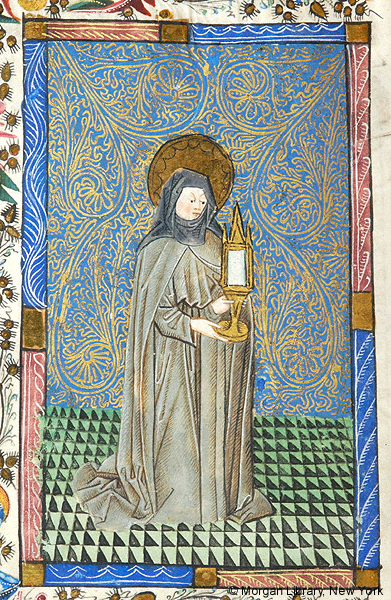
Nun holding a reliquary. Source: The Morgan Library and Museum

Lymewald

Deep Winter, 2nd Month of the Year

2ChimeThe Feast of St. Waylord.
3HaymeThe Feast of St. Gondyw.

Pluritine Observances: Blackeswell hosts the largest observance, where the people put on a pageant showing the old kings converting to the Pluritine faith and driving out the "snakes" of the old religions. Smaller pageants occur elsewhere.

9ChimeThe Feast of St. Calafredus.
15CollyThe Feast of St. Wynne.
19FriskThe Feast of St. Albrith.
23ChimeThe Feast of St. Fredulus.
28SunningThe Feast of St. Eggort.

Pluritine Observances: It is custom to keep a simple beeswax candle lit through the night, from sundown on the 28th of Lymewald to sunup on the 1st of Haggryme. This is said to help guide lingering souls to the afterlife.

++++ Like what you just read? You can subscribe to new posts on this blog via any ActivityPub platform (Mastodon, Pleroma, etc.) at @aaron@blog.hilltown.studio or via RSS at https://blog.hilltown.studio/feed

#Dolmenwood #resources #development

I started playing around with the Dolmenwood calendar recently, as I was gearing up for my upcoming campaign. Initially, I was just going to write down in an Obsidian page my own collection of folk and religious observances for the major feast days and pre-Pluritine holidays, but when I re-encountered Grisly Eye's vellum-doc project again, I decided to give that a whirl.

I started with House Rules but then decided to import some of my calendar entries to see how those looked in the same setup. I had already committed to using medieval illustrated manuscripts as imagery, and it wasn't long before I came across historical examples of Books of Hours, which, as luck would have it, usually include calendars of feast and saints' days. And thus was born the Dolmenwood Book of Hours.

Now, I have considerable work left to do on it, so what I will do in a series of posts here is detail each month's major feast days and whatever folk holidays I plan to include myself. Once the major saints and holidays are accounted for, I will go back and create smaller, less grandiose observances for the saints who merited only a mention in one table in the Dolmenwood Campaign Book.

The methodology for creating these observances for major saints is as follows:

  1. Determine if the saint is the patron saint of anything in particular. If so, build an observance around that patronage. If not...
  2. Try to find the blessing associated with the saint, then see if it makes sense to build an observance around that. And if not...
  3. Use the epithet attached to the saint, on the assumption that the epithet says something useful about the saint where the lore itself does not.

Since there are 34 major saints, plus a smattering of other holidays (mostly folk stuff), the work is approachable if time consuming. There are 100 saints in all, however, and since the remaining saints may have only epithets attached to them, I'll have to basically invent lore for most of them. I will take the lack of lore for these as an invitation to brew my own, knowing full well that a later supplement may obviate this effort. In the meantime, the Book of Hours

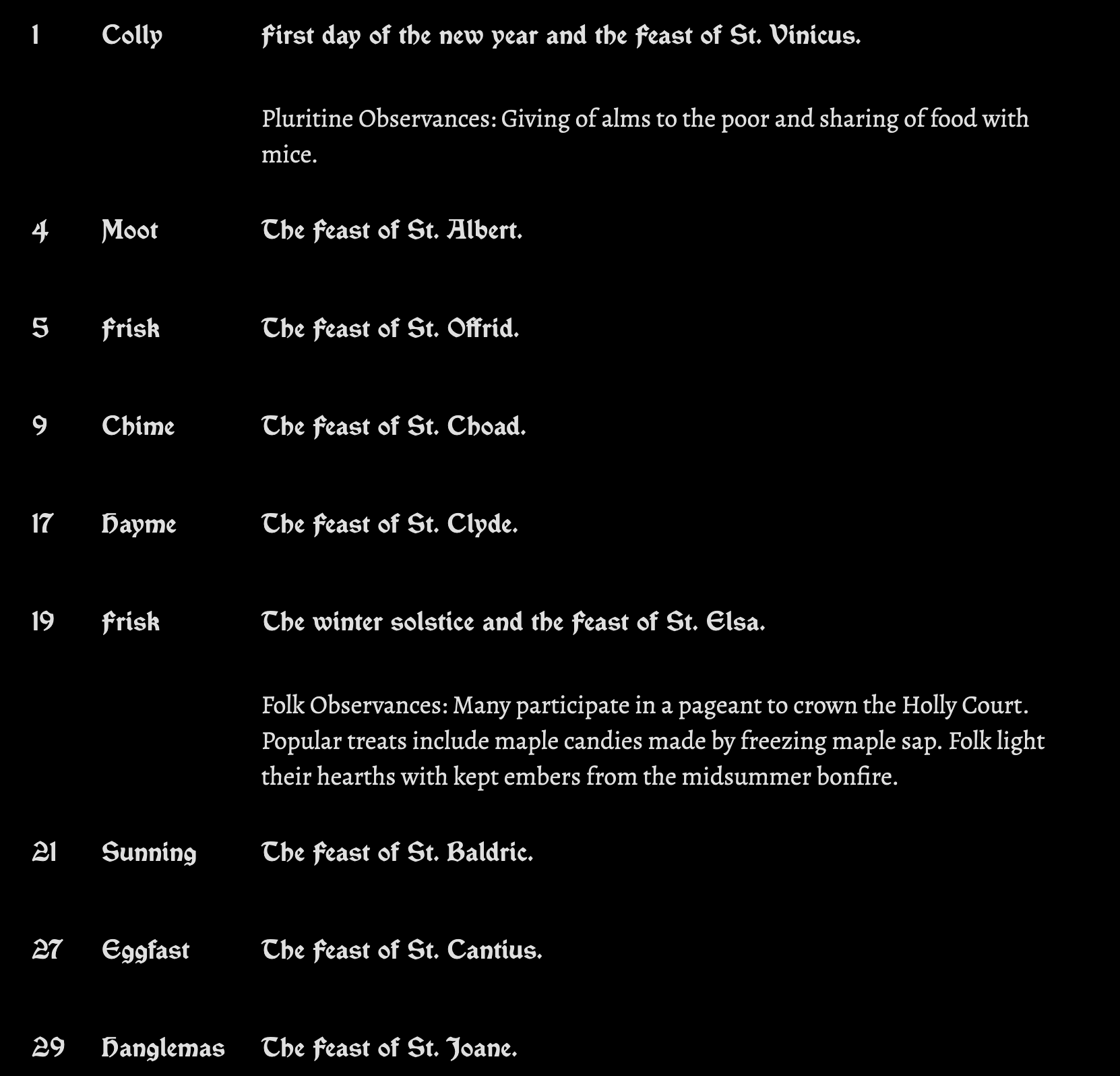
In any case, here is the list for Grimvold, The Onset of Winter, 1st Month of the Year.

Grimvold

++++ Like what you just read? You can subscribe to new posts on this blog via any ActivityPub platform (Mastodon, Pleroma, etc.) at @aaron@blog.hilltown.studio or via RSS at https://blog.hilltown.studio/feed